Discover the Florida Everglades: Facts, Fun and Fascinating History
The Florida Everglades in south Florida is one of the world’s most unique and fragile ecosystems.
Often thought of as a swamp, the Glades are actually a slow-moving river flowing over an area 40 miles wide by 100 miles long, from the south shore of Lake Okeechobee to the mangrove estuaries of Florida Bay.
These are just a few of the Everglades facts you’ll find here as we introduce you to the incredible watershed of the Florida Everglades.
Did you know that Naples and Marco Island sit at the gateway to the Florida Everglades? It’s hard to believe you can be lounging on the beautiful Naples beaches one day and hip-high in alligators the next.
Exploring the largest remaining subtropical wilderness in the United States is one of the best things you can do in Southwest Florida. It’s all right outside your door.
The Everglades is like no place else on earth — home to endangered, rare, and exotic wildlife living on over 1.5 million acres of saw grass marshes, mangrove forests, and hardwood hammocks dominated by wetlands.
So let’s dive in the Glades, learn some Everglades facts and history, share some fun Everglades facts for kids, and info on how you can get out and explore it all.

The slow moving River of Grass from above
Origins of the Everglades
At its origin, the Kissimmee River in north central Florida flowed to Lake Okeechobee, which continued southward to the low lying Biscayne Bay on Florida’s east coast, and the Ten Thousand Islands in southwest Florida to Florida Bay.
During the wet season, water leaving the lake formed a slow-moving shallow river 60 miles wide and 100 miles long. Over thousands of years, a balanced ecosystem of ponds, marshes, and forests was created.
This broad fragile expanse once covered an area of over 4,000 square miles. But development, significant habitat destruction, and environmental degradation, including polluted water from Lake Okeechobee, have reduced the size of the Everglades to just half that size today.
Although wading birds such as egrets, wood storks, and a variety of herons are still present, their numbers have been greatly impacted by development.
Other Everglades animals have also reduced in number. The historic range of the Florida panther at one time included the swamplands of Everglades National Park and Big Cypress National Preserve.
These big cats are the only subspecies of mountain lion remaining in the eastern United States. Sadly, they are often struck by cars at night, and are now critically endangered due to habitat destruction. With only 70-100 remaining in the wild, the Florida panther is one of the most endangered animals in the world.

The impressive and endangered Florida panther
Draining the Swamp
In the 1800’s, early settlers and land developers considered the Everglades to be a worthless swamp, and developers began digging canals to drain the wetlands.
Around 1905, large tracts of land were converted to agriculture, and this “new” landscape stimulated the first of South Florida’s land booms.
When Henry Flagler constructed the first railroad down the Florida peninsula, Florida was officially open for business though it took a few years for less intrepid folks to come.
Eventually, new residents flocked to the newly-developed towns of Miami, Fort Lauderdale, and Fort Myers in the 1920s, swelling the population and fueling the demand for housing.
To accommodate the demand canals were built to drain the Glades, and more and more roads and buildings encroached further into the Everglades destroying the natural habitat along the way.
Were it not for the efforts of countless individuals in the decades following who battled various initiatives to expand housing and growth through the Glades, the tide may have turned a different way.
People like author and activist Marjory Stoneman Douglas who organized the Friends of the Everglades in the 1960s to battle the federal government’s plan to build an airport in the Everglades.
Or persistent landscape architect Ernest Coe who began to politic for the establishment of a national park and kept at it until Congress finally passed legislation in 1934 establishing Everglades National Park.
The Everglades Today
Today, at only half of its original 4,000 square miles, the list of endangered animal species and some native plant species in the Everglades continues to grow.
Along with the Florida panther the list includes the West Indian manatee, the Miami black-headed snake, the American crocodile, the wood stork, and the Cape Sable seaside sparrow.
And the number of wading birds in the Everglades has been reduced — as much as 90% of the pre-existing population by some estimates.
Invasive species such as exotic plants, pets, and destructive insects often inadvertently introduced by humans, are also an ongoing threat.
The loss of habitat and the subsequent loss of food sources that native species depend on raises the danger of extinctions.
Perhaps the greatest threat to Everglades wildlife in recent years is the human-introduced Burmese python which basically will eat whatever it can fit in its mouth.
There has been some success in controlling the python population though their numbers continue to grow.
But the news on the Everglades habitat is not all grim.
In 1976 the Everglades were declared an International Biosphere Reserve, followed three years later in 1979 as a UNESCO World Heritage Site and a Wetland of International Importance.
Thankfully, these designations, along with more visitors discovering the beauty of the Florida Everglades by exploring its furthest reaches should help create awareness of the fragile ecosystem balance and its significance to the health and well being of Floridians and the planet overall.

The Florida Everglades are a watery wilderness perfect for nature lovers
Habitats of the Florida Everglades
Because of the small changes in land elevation throughout the Everglades ecosystem, there are many unique types of habitats to explore in the Everglades including sawgrass marshes, open-water sloughs, cypress swamps, hardwood hammocks, mangrove swamps, and pinelands.
While it all may seem like a big swamp to some, you don’t have to be an outdoor lover or naturalist to appreciate the delicate balance that exists in the Everglades.
One visit to the Everglades is usually all it takes for visitors to see the “swamp” with new eyes.
But visit at different times of the year, and the ever-changing landscape will pique your curiosity even more.
Chances are the Glades will be greener or drier and more brown from one visit to the next.
Seasonal and environmental changes — some more subtle than others — in temperature, amount of rainfall, humidity, wild fires, and other factors affect the look, feel, smell, and behavior of the Everglades ecosystem every day.

Paddling through a primordial Everglades forest
How to Explore the Florida Everglades
Despite the important designations and protection afforded the Everglades in recent years, this vast wilderness is still one of the least visited of the US national parks.
Now is a great time to visit and see what’s so special about this primordial place.
You can easily visit the Everglades as a day trip from Naples or Marco Island.
Everglades National Park is under an hour away from Marco Island.
But you don’t necessarily have to go to the National Park to be in the Everglades. Corkscrew Swamp Sanctuary and CREW Bird Rookery Swamp are both located in Naples and part of the Everglades.
Any time of year is a good time to visit but bird and wildlife watchers, anglers, campers, and hikers seem to agree that visiting the Everglades during the winter months is the best time to visit.
When it’s not so hot, the swarms of biting insects aren’t as bad, and conditions are better for viewing wildlife.
To immerse yourself in the Everglades, hop in a kayak or canoe, or take a guided kayak tour with a Florida naturalist and paddle along water trails, through mangrove tunnels, and along secluded estuaries.
Pick one of nine entry points to complement your preferred activity. Paddling, cycling trails, and fishing are some of the best ways to slow travel and truly experience the Glades.
For a more rugged experience take a guided hike or swamp walk, sometimes in knee or waist deep water, to see what most visitors miss.
Hike Corkscrew Swamp
Corkscrew Swamp Sanctuary is the largest stand of old-growth cypress trees on earth (some are huge) and one of our favorite day hikes to take around Naples.
It’s like walking back into a prehistoric world.
There’s a rare beauty here — quiet and peaceful except for the sounds of birds and tree frogs.
You can hike on the long boardwalk over 2 miles long, and stop where you like for photos or just to watch and listen.

Hiking in the Everglades is made much easier with elevated boardwalks
Step Through the Fakahatchee Strand
Fakahatchee Strand Preserve State Park is the largest State Park in southwest Florida, and offers a casual hike along an elevated boardwalk trail meandering over small lakes and waterways.
You might get lucky and hear a Florida panther scurrying about under the walkway, or catch a glimpse of the elusive ghost orchid.
What you mostly will see are wading and fishing birds and lots of gators.
Visit the Shark Valley Visitor Center
There are no sharks to see at Shark Valley Visitor Center, and certainly no valleys, but this is still a great place to stop especially with kids.
There’s all sorts of information about the Everglades, fun and interesting exhibits, hiking trails and cycling paths, and a 15- mile loop trail.
A guided tram tour is a great way to experience the trail, and at the half-way point of the tour, a 45 foot high observation deck gives visitors an opportunity to experience panaramic views of the Everglades, extending outward 20 miles in all directions.

The scenic overlook at the Shark Valley Visitor Center
Hike Big Cypress
Big Cypress National Preserve encompasses 720,000 acres of swamp and marsh wilderness.
Nearly every species of wildlife in the Everglades can be found here by hiking, cycling, or venturing down the 25-mile Loop Road that will take you deep into this pristine wilderness.
Alligators? Yes, many!
Take an Everglades Boat Tour
What better way to explore the “River of Grass” than in a boat, and there are several kinds of boat tours in the Everglades that are completely unique to this type of ecosystem.
Airboat tours are probably the most well-known and popular tours.
There’s nothing quite like gliding across the open stretches of watery grasslands or through mangrove tunnels than on an Everglades airboat tour.
If something slower or more serene is what you’re looking for, try an Everglades pole boat tour, the kind of tour led only by the traditional Gladesmen in the area.
There are also many small boat tour operators in the Everglades who can take you and your family on an interesting tour to see wildlife, the local flora, and even a few alligators.
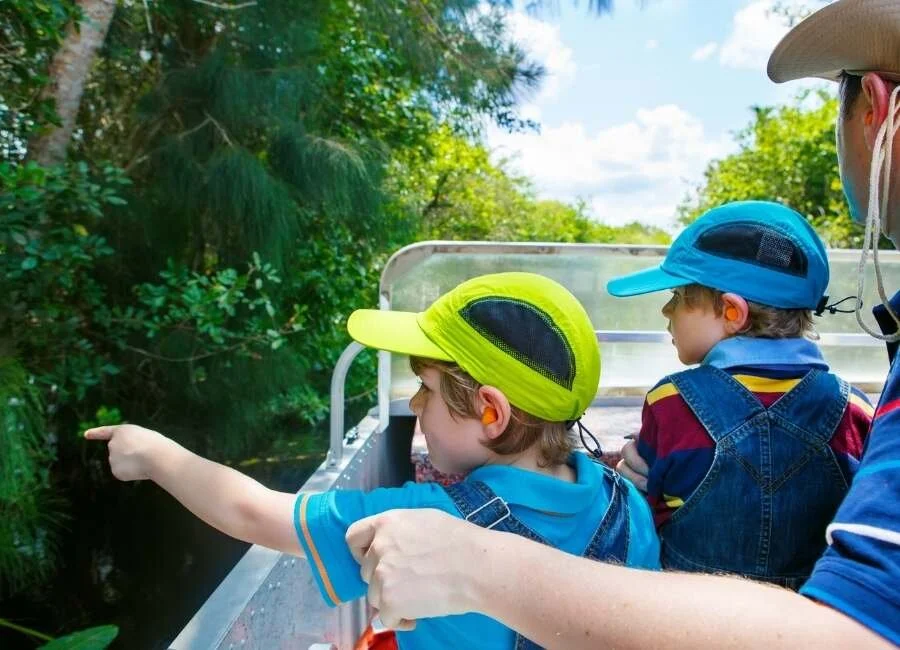
Taking an Everglades boat tour is a great way to explore the Glades
Go Everglades Camping
If you love camping and want to try something completely new, you’ll want to go camping in the Glades, and there are a few ways to do it.
You can of course go tent and RV camping at one of several campgrounds in the Everglades.
There are even some pretty glam set-ups in screened and elevated cabins if you don’t want to rough it.
But it’s the backcountry camping in the Glades that’s popular with hikers and outdoor lovers.
You can go beach camping, or for something really unique — try chickee hut camping on elevated boardwalk structures over the water.
With a chickee hut, you’ll pitch your tent on a traditional Seminole structure — a raised wooden platform covered with a thatched roof and open on all sides.
Paddle to the chickee which will have places to tie up your kayak or canoe. It’s a great way to experience a new wilderness camping adventure.
Is Robert Really at His Fruit Stand?
If you start your Everglades exploration near Homestead, stop in and see if Robert is in.
At the Robert Is Here fruit stand, you can browse the aisles for exotic produce – dragonfruit, lychee, sapodilla, Monstera deliciosa – as well as more familiar fare, like tomatoes cucumbers, bananas, mangoes and more.
Owner (and namesake) Robert Moehler, is a big, friendly guy who will talk your ear off, but he grows most of what he sells, and makes a mean milkshake.

Robert is here and he’s on the phone
8 Great Everglades Facts to Know
1. Everglades National Park is the 3rd Largest National Park
Everglades National Park is the 3rd largest national park behind Yellowstone and Death Valley.
The National Park itself is 1.5 million acres of preserved wetlands.
With the addition of adjacent National Preserves like Big Cypress and other smaller State Parks, the entire Florida Everglades comprises nearly 5 million acres.
2. Alligators move around on land in three different ways
If there’s one animal you’ll see a lot of in the Florida Everglades it’s the alligator, but don’t let their lumpy size or lack of movement fool you — they’re incredibly agile and quick to ambush their targets.
Alligators move around in three different ways on land: they high walk (when they aren’t in a hurry), belly walk, and belly run.
You’ll often see alligators sunning themselves and not moving.
That’s just them being alligators and conserving energy.
The body of an alligator is 68% muscle — so give them a wide berth if you see one.

Fun Everglades facts for kids: Alligators move around on land in three unique ways.
3. Humans in the Everglades
Did you know that evidence of human settlement in the Everglades dates back thousands of years? It’s true!
From the original Archaic period settlements to the modern tribal communities of the Miccosukee and Seminole Indians, the region has a rich history of human culture.
Early settlers known as “Gladesmen” explored south Florida’s natural landscape and became adept at navigating the waterways — and some still do today.
4. The Everglades is Not Actually a “Swamp”
The Everglades is not actually a “swamp”, but a slow moving river. The ‘River of Grass’ runs south to southwest from Lake Okeechobee — the largest freshwater lake in Florida — and flows through south Florida, finally draining into Florida Bay between southwest Florida and the Florida Keys.
5. HM69 Nike Missile Base
Unknown to most visitors to the Everglades is a preserved relic of the Cold War when the US and Russia had missiles aimed at each other.
The site designated as “Alpha Battery” or “HM69” on Long Pine Key Road in the Everglades National Park housed Nike Hercules missiles and a lot of US troops.
The US believed this was a place that the enemy would never look for a missile defense system, and they were probably right.
Now listed as a historic site, the missile base has since been abandoned, but it’s still interesting to think about what went on here.
You can visit the site from December through March and take a guided tour. For more information, check out the Ernest F. Coe Visitor Center.

The HM69 Nike Missile Base, a curious site in the Everglades
6. Alligators and Crocodiles CoExist only in the Everglades
Ready for one of the most interesting Florida Everglades facts about animals?
Everglades National Park is the only place in the world where American alligators and American crocodiles coexist in the wild.
Crocodiles typically live in saltwater habitats, and alligators are mainly found in freshwater marshes and lakes but in the Everglades, crocodiles and alligators can be found living together in the wild.
They do closely resemble each other so how can you tell the difference?
Alligators have a broader U-shaped snout and are generally darker in appearance, while crocodiles have a more pointed, slender V-shaped snout and are typically a lighter, grayish brown.
7. The water level in the Florida Everglades is just 9 feet at its deepest point
The average depth of the Everglades is 4 to 5 feet.
Not that you should go for a swim — your best bet is to stay within the safe confines of an airboat or safely on your hiking path.
8. Home to Unique Species
The Everglades is teeming with species not found anywhere else on the planet and provides important habitat for numerous animal species like the manatee, American crocodile and the elusive Florida panther.
The park has long been a birder’s paradise as well — it is the winter home of more than 360 different species of birds.
Did you know any of these interesting Everglades facts and unique history? We’d love to hear more from you and how you’ve explore the Florida Everglades.


Categories
Recent Posts


